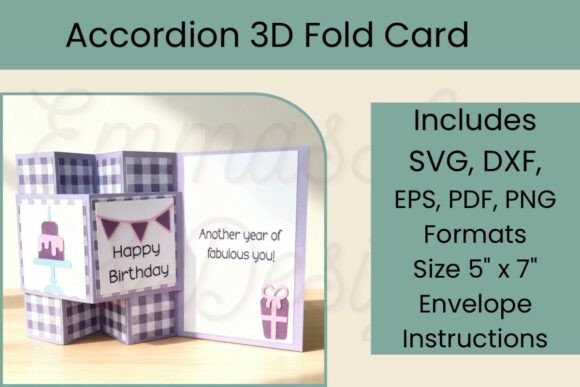
3D SVG Accordion Fold Birthday Card
As a designer who spends half my life staring at stitch charts and the other half trying to sell handmade goods, I don’t just look at an embroidery file; I look at its potential. When I first pulled up the 3D SVG Accordion Fold Birthday Card, my immediate reaction wasn't about the "pop-up" nature of the graphic itself, but rather how that specific geometry translates when rendered in thread. This isn't just a flat image; it is a structural concept. For those of us running small shops or crafting personalized gifts, the question is always: does this design hold up on fabric?
The core appeal of this machine embroidery design lies in its layered birthday cake and candle motif. Visually, it screams celebration, but practically, it offers a fascinating challenge for the embroiderer. The accordion fold implies depth, layers, and dimensionality. In the digital realm, this looks crisp and clean. But in the physical realm, we are dealing with thread tension, fabric stretch, and the limitations of our hoops. My review here focuses on whether this 3D SVG Accordion Fold Birthday Card delivers the visual impact needed for high-end custom apparel and boutique merchandise, or if it remains better suited for paper crafts.
First Impressions: Mood and Visual Personality
The mood of this design is undeniably joyful and nostalgic. It taps into the universal imagery of a birthday cake, which makes it highly marketable. However, from a design perspective, the "accordion" aspect suggests a zig-zag or pleated structure. If you are planning to use this as an embroidery project on a tote bag or a sweatshirt, you have to decide how much of that structural complexity you want to commit to in thread.
The layered cake design provides excellent opportunities for contrast. You can use different thread colors to separate the cake tiers, mimicking the look of frosting layers. The candles offer vertical lines that break up the horizontal stacking of the cake. This creates a balanced composition that works well centered on a garment or placed asymmetrically on a tote bag design. It feels friendly, approachable, and perfect for personalized gift items where the recipient wants something cute but not overly childish.
Real-World Application: Where Does It Fit?
I recently tested the concept of this design on a few different substrates to see where it truly shines. Here is where I see the most success for this digital embroidery file:
- Custom Apparel: On a cotton sweatshirt or a heavyweight t-shirt, the layered cake holds its shape beautifully. The fill stitches used for the cake body provide enough density to stand out against the fabric texture.
- Baby Embroidery: This is a top contender for baby onesies or burp cloths. The soft, rounded shapes of the cake and candles are gentle and appealing for nursery decor or baby shower favors.
- Kitchen Textiles: An embroidered patch or direct-to-garment style transfer onto a tea towel or apron adds a whimsical touch to the kitchen. The theme fits perfectly with homey, handmade aesthetics.
- Craft Business Merchandise: For an Etsy seller or small shop product owner, this design is versatile. It can be printed on printable mockups for digital sales or stitched onto physical goods for craft fair booths.
However, the "Pop-Up Cards" category usually refers to paper engineering. When translating this to an applique design or standard embroidery, you lose the actual mechanical folding. Instead, you rely on visual layering. If your customers expect a literal pop-up card made of fabric, this might be misleading. But if they expect a card *featuring* this design, or an item that celebrates that same 3D aesthetic, it works wonderfully.
Technical Considerations and Stitch Clarity
Not every design survives the transition from screen to hoop. With the 3D SVG Accordion Fold Birthday Card, there are specific areas to watch.
Stitch Density and Detail: The candles are thin elements. If the stitch density is too high, they might pucker. If it’s too low, they might look sparse. I recommend checking the running stitch or satin stitch settings for these thin lines. They need to be distinct enough to read as flames or wicks without consuming too much thread.
Fabric Texture: This design performs best on stable fabrics like cotton twill, denim, or felt. Avoid stretchy knits unless you use a strong cut-away stabilizer. The layered nature of the cake means you have multiple blocks of color. On a textured fabric like bouclé or heavy wool, the details might get lost. Stick to smoother surfaces for maximum clarity.
Hoop Size Constraints: Because this design features a central subject (the cake) with potential surrounding elements (like the accordion folds), ensure your chosen hoop size accommodates the full width. If you try to squeeze a wide accordion layout into a small hoop, you may end up cropping the edges, ruining the symmetry.
Where to Use It Carefully
While this design has broad appeal, there are places where it might struggle:
- Small Hoop Sizes: Trying to fit intricate layer details into a tiny hoop can result in a muddy appearance. Keep it simple or scale down appropriately.
- Dark Fabric: If you are stitching light-colored threads on dark fabric, ensure there is enough contrast. The subtle shading of the cake layers might disappear if the background is too dark and the thread is too light.
- Curved Surfaces: While it can work on a cap, the flat, layered look of the cake might distort slightly on the curve of a hat brim. Test this before committing to a bulk order.
- Dense Stitch Areas: If the design includes heavy fill stitches for the cake base, avoid using it on thin fabrics that might show through to the front side.
Design Notes for the Professional Crafter
Before you upload this to your machine, take these steps to ensure a professional finished product:
- Test on Scrap Fabric: Always run a test stitch-out. Check how the thread colors interact with your specific fabric shade.
- Review Stitch Density: Look at the digital preview. Are the fill stitches overlapping cleanly? Is there any unnecessary trimming that might leave loose ends?
- Black and White Mockup: Convert the design to grayscale. This helps you see if the contrast between the cake layers and the background is sufficient. If it looks gray and indistinct in black and white, it will likely look muddy in color.
- Check Licensing: As a commercial embroidery asset, verify the license terms. Can you sell the finished physical items? Can you use it in design assets for clients? Never assume.
- Stabilizer Choice: Use a quality tear-away or cut-away stabilizer depending on the fabric weight. A weak stabilizer will cause the "accordion" lines to shift, ruining the geometric integrity.
Final Verdict on Value and Appeal
The 3D SVG Accordion Fold Birthday Card is more than just a cute image; it is a structural opportunity for designers. It allows you to create handmade products that feel thoughtful and detailed. Whether you are creating a holiday embroidery gift, a wedding gift favor, or a staple item for your craft business, this design offers a sweet spot between simplicity and visual interest.
It builds customer trust because it looks professional and intentional. The layered cake is a classic symbol, making it instantly recognizable, while the accordion fold concept adds a modern twist that sets it apart from generic birthday designs. For the creative entrepreneur looking to expand their catalog with reliable, high-quality embroidery files, this is a solid addition. Just remember: the magic happens in the execution. Choose your fabrics wisely, respect the stitch limits, and let the design do the talking.